Resources: These include material and intangible assets such as physical/digital collections, facilities, sector-specific knowledge, and labor (both waged and volunteer).
Community: A diverse grouping of professionals, users, audiences, and interest groups—referred to as a “community of commoners”—who collectively appropriate, manage, and care for the resources.
Governance/Management: A relational framework established through a mix of formal and informal rules and horizontal decision-making processes.
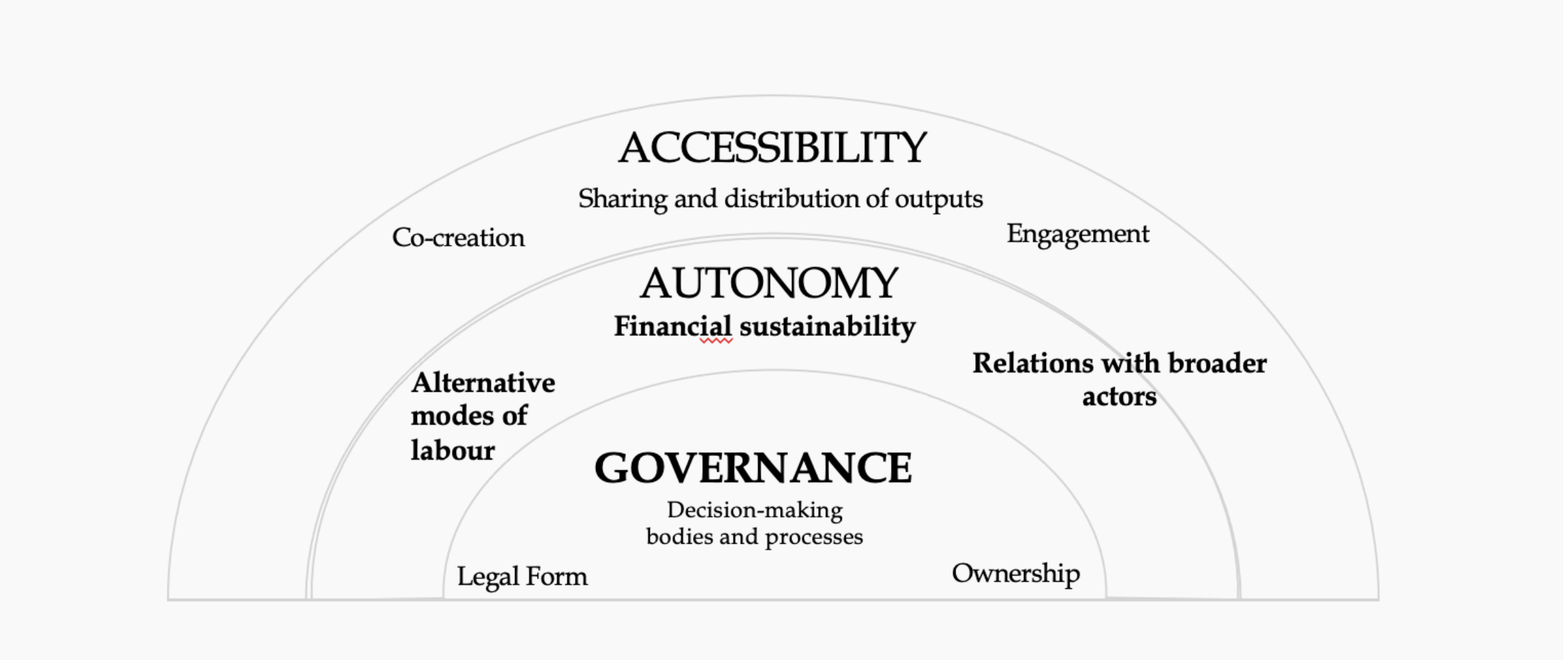
The framework organises commoning practices around a relational hierarchy of three principles that define a GLAM’s potential to operate as a commons:
Rather than viewing institutions as bounded entities, the framework treats GLAMs as porous circuits. Their boundaries are continuously challenged and transformed through relations with society, social movements, and other modes of urban/digital commons. This model facilitates a “multi-spatiality” where material resources (original artefacts) are managed locally, while intangible resources (digital archives, metadata) are shared across global networks.
Ultimately, the GLAMMONS framework serves as a device for communities assembled around a collective interest in the past to preserve and transform that heritage through a management structure and ethos of inclusive democracy and solidarity.