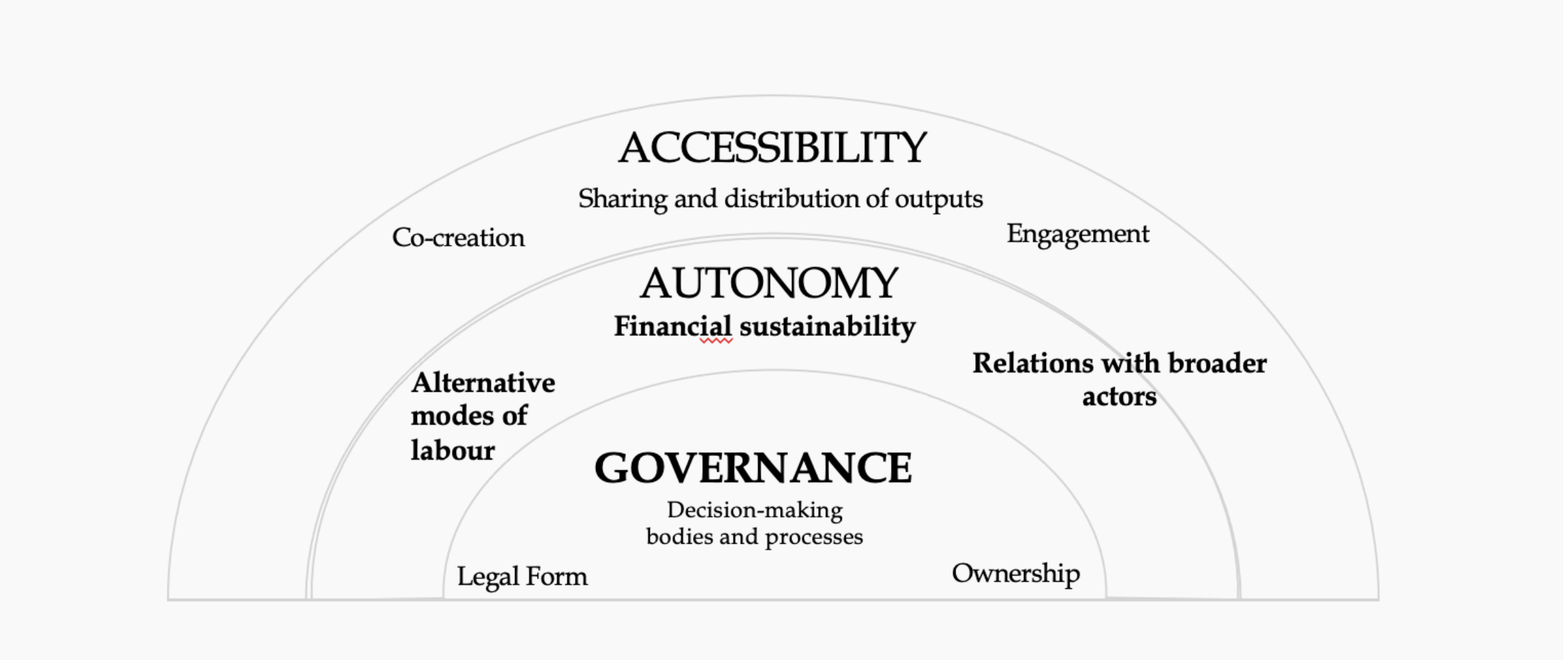
framework

The GLAMMONS framework proposes a novel conceptualisation of Galleries, Libraries, Archives, and Museums as commons: social systems dedicated to the long-term stewardship of cultural and heritage resources that produce and preserve shared values and community identity. This framework provides an alternative mode for governing and managing cultural heritage against a backdrop of limited public funding and pressures for memory institutions to become more inclusive, participatory, and resilient.
The framework is built upon a tripartite ontology comprising three essential components:
  • Resources: These include material and intangible assets such as physical/digital collections, facilities, sector-specific knowledge, and labor (both waged and volunteer).
  • Community: A diverse grouping of professionals, users, audiences, and interest groups—referred to as a “community of commoners”—who collectively appropriate, manage, and care for the resources.
  • Governance/Management: A relational framework established through a mix of formal and informal rules and horizontal decision-making processes.

The Core Principles of GLAMMONS

The framework organises commoning practices around a relational hierarchy of three principles that define a GLAM’s potential to operate as a commons:

  1. Governance: Situated at the core, this requires inclusive, horizontal decision-making bodies (such as general assemblies or extended boards) and a supportive legal status (e.g., cooperatives, non-profits, or SSE initiatives).
  2. Autonomy: Focuses on developing financial sustainability and self-governance by limiting dependencies on state and corporate actors that might impose top-down hierarchies.
  3. Accessibility: Accomplished through practices that ensure wide community engagement, the sharing and distribution of outputs, and the use of open-access tools.

The “Porous Circuit” Model

Rather than viewing institutions as bounded entities, the framework treats GLAMs as porous circuits. Their boundaries are continuously challenged and transformed through relations with society, social movements, and other modes of urban/digital commons. This model facilitates a “multi-spatiality” where material resources (original artefacts) are managed locally, while intangible resources (digital archives, metadata) are shared across global networks.

Commoning Practices for Professionals

For GLAM professionals, the framework identifies specific commons-oriented practices to transition away from traditional top-down models:
  • Co-creation: Moving beyond mere “public involvement” to designing projects with the public, where goals and implementations are co-decided.

  • Open Access & IPR: Utilizing Creative Commons and open licensing to ensure that cultural goods belong to the public and can serve as future input for further creation.

  • Knowledge Sharing: Leveraging digital repositories and cloud-based infrastructure to facilitate a polyphonic interpretation of history and heritage.

  • Transformative Sharing: Providing infrastructure and spaces for underprivileged groups to claim visibility and bring out neglected sides of collective memory.

Ultimately, the GLAMMONS framework serves as a device for communities assembled around a collective interest in the past to preserve and transform that heritage through a management structure and ethos of inclusive democracy and solidarity.